How to Calculate Multiple Discounts: Is 20% Off Plus 10% Off Really 30% Off?
Find out why stacked discounts like 20 percent off plus 10 percent off do not equal 30 percent off, and learn how successive store reductions really work.
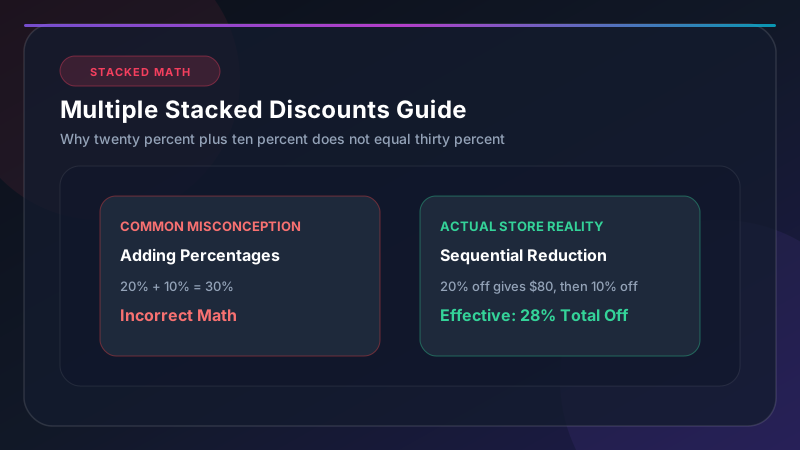
Two discounts can look like a spectacular bargain. But “20% off plus 10% off” does not normally equal 30% off the original price. The second discount usually applies to the already reduced amount.
What Are Multiple or Stacked Discounts?
Multiple discounts occur when two or more reductions apply during one purchase. Stores may combine a sale with a coupon or offer an additional percentage at checkout.
Is 20% Off Plus 10% Off Equal to 30% Off?
No. Suppose an item costs $100. A 20% reduction leaves $80. A further 10% reduction removes $8 from $80. The final price is $72, meaning the effective discount is 28%.
How Successive Discounts Work
With successive discounts, each reduction applies to the price remaining after the previous discount. Think of it like peeling layers from an onion. Every percentage acts on a smaller amount.

How to Calculate the First Discount
Start with the original price. For $200 at 20% off, calculate $200 × 0.20. The first discount amount is $40, leaving $160.
How to Apply a Second Discount
Now apply the second percentage to $160. A 10% discount removes $16. The final sale price becomes $144.
The Formula for Multiple Discounts
The formula is:
Final Price = Original Price × (1 − First Rate) × (1 − Second Rate)
For 20% and 10%, that becomes $200 × 0.80 × 0.90 = $144.
Examples of Stacked Store Discounts
Consider a $500 appliance with 15% off followed by 10% off. The first reduction produces $425. The second removes $42.50. The final cost becomes $382.50.
Coupons Plus Sale Discounts
A store coupon may apply after a sale discount, although retailer rules vary. Some coupons cannot combine with promotional pricing. Always read the offer conditions before assuming discounts stack.
Effective Discount Percentage Explained
The effective rate shows the total reduction compared with the original price. In the 20% plus 10% example, the shopper pays 72% of the original amount. Therefore, the combined discount percentage equals 28%.
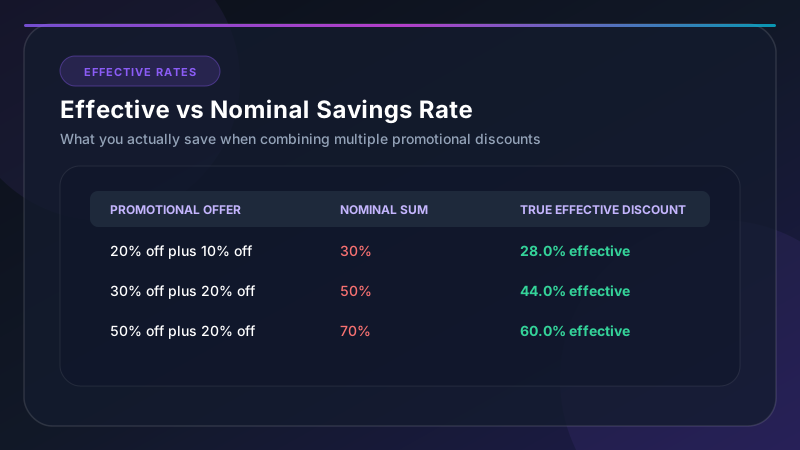
How to Calculate Multiple Discounts Instantly
A multiple discount calculator can process several reductions without repeated arithmetic. However, understanding the method remains valuable because it helps verify whether an advertised additional discount really produces worthwhile savings.
When comparing promotions, focus on the final amount rather than adding percentages together. That simple habit can prevent surprisingly common shopping mistakes.
Conclusion
Multiple discounts do not usually add together in the way shoppers expect. A 20% discount followed by another 10% discount is not the same as getting 30% off the original price. Each discount applies to the price remaining after the previous reduction. Understanding successive discounts helps you calculate the true savings and avoid overestimating a store’s deal.